Most decks in Dublin don’t fail because of bad timber. They fail because nobody cleaned the gaps between the boards for three or four years and the deck sat wet from October through to April. If your deck is going green, feels soft in one corner, or has started to wobble near the steps, the honest answer is that it can usually be restored or repaired rather than ripped out, but how far that goes depends on what’s happening underneath the boards, not just what you can see on top.
Why Dublin Decks Age Faster Than People Expect
We’ve been doing this across Dublin for over 21 years, and the pattern is pretty consistent. A deck in a sheltered, sunny spot in Terenure or Rathfarnham can go a decade with just an annual clean. The same deck facing north in a tight city garden in Drumcondra or Glasnevin, boxed in by walls and overhanging trees, can be in trouble within five or six years.
It’s not really the rain that does the damage, it’s what happens after the rain. Irish weather gives timber plenty of water and not much drying time between showers. Leaves and moss sit in the gaps between boards, block the drainage channels, and hold moisture against the wood. That’s when rot starts, almost always from underneath, which is exactly why a deck can look fine on the surface right up until a board gives way underfoot.
Closer to the coast, around Dun Laoghaire, Blackrock and Clontarf, we also see salt air speed up corrosion on cheaper screws and brackets. If a deck was built with budget fixings, that’s often where the first real problems show up, not in the timber itself.
Repair, Restore or Replace? How We Actually Make That Call
Homeowners usually ask us this on the phone before they even book a visit, and the honest answer is “it depends what’s holding the deck up.” A worn, grey-looking surface with sound boards underneath is a restoration job: a deep clean, sanding back if needed, and a fresh coat of oil or stain. That’s cosmetic and relatively quick.
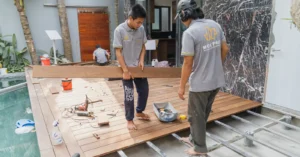
A genuine repair is when specific boards, joists or the frame have failed but the rest of the structure is sound. We’d replace the damaged sections, check the joists underneath for softness with a screwdriver (if it sinks in easily, that timber is compromised), and make sure drainage and airflow underneath are sorted so the same spot doesn’t fail again in two years.
Replacement is the right call when the substructure itself is going, when rot has spread to multiple joists, or when the deck is old enough that patching it would just be delaying the inevitable. We cover all three properly, from decking repairs on specific problem areas through to full decking replacement where the frame has had it.
A Maintenance Routine That Actually Works in Dublin
We’d rather a homeowner spend an hour twice a year than call us for an emergency repair in three. This is the routine we’d genuinely follow ourselves:
- Clear leaves and debris from between the boards every autumn, not just once a year in spring. This is the single most skipped step and the biggest cause of early rot.
- Give the deck a proper clean (a stiff brush and a dedicated decking cleaner, not just a hose) in spring to remove algae and green growth before it gets a grip.
- Check underneath once a year if you can access it. Look for soft joists, standing water, or gaps where soil or plants have grown up against the frame and are trapping moisture.
- Reapply oil or stain to timber decking roughly every one to two years, more often on exposed or shaded areas, before it starts to look grey and dry.
- Avoid pressure washers on timber unless you really know what you’re doing. A high setting strips the natural fibres and leaves the wood rougher and more absorbent, which speeds up the next round of damage.
Timber and Composite Need Different Care
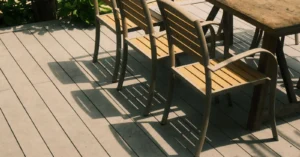
People often choose composite decking expecting to do nothing to it, and while it’s a fair bit less demanding than timber, “low maintenance” isn’t “no maintenance”. Composite doesn’t rot, but algae and mould can still build up on the surface in shaded, damp Dublin gardens, and it needs a wash a couple of times a year to stay looking right.
Timber decking gives you a warmer, more natural finish and it’s usually the better match for older Dublin houses and period gardens, but it asks more of you: regular oiling, a closer eye on the joints and fixings, and quicker action when a board starts to feel soft. Neither is the “wrong” choice. It genuinely comes down to how much upkeep you want to commit to versus the look you’re after.
What Pushes a Repair or Restoration Cost Up or Down
We don’t quote prices without seeing the job, because two decks that look similar from the street can be completely different jobs underneath. What we can tell you is what moves the number:
- Access. A deck you can walk straight up to with a trailer is far cheaper to work on than one down a narrow side passage or up steps at the back of a terraced house.
- How much of the frame is affected. Swapping a few surface boards is a small job. Rotten joists mean lifting the deck boards to get at the frame, which adds time and materials.
- Raised or elevated decks. Anything built up off sloped ground, common on raised decking jobs in gardens with a level change, involves more structural work to repair safely.
- Timber grade and finish. Matching existing hardwood or a specific stain colour takes more time than a standard softwood repair.
- How long the problem has been left. A deck caught early is a repair. A deck left two more winters with the same soft spot is often a replacement.
If you want a proper assessment rather than a guess over the phone, it’s worth having someone look at it in person. You can see the full range of what we cover on our decking services page.
Why DIY Maintenance Sometimes Makes Things Worse
We’re not against homeowners doing their own cleaning and oiling, that’s exactly what keeps a deck going between proper check-ups. Where it goes wrong is when people treat a structural issue as a cosmetic one. Painting over a soft board, screwing a loose joist back down without checking why it moved, or oiling over timber that’s already damp underneath just hides the problem for another season. By the time it reappears, it’s usually bigger and more expensive to put right. If a board feels spongy, bounces more than it should, or the frame has visible gaps opening up, that’s the point to get someone to look at the structure, not reach for the sander.
Get a Proper Look Before You Decide
If your deck is tired, damp, or just not ageing the way you expected, the quickest way to know what you’re actually dealing with is to have it looked at by someone who does this for a living. We’ve been installing, repairing and restoring decks across Dublin, from Swords down to Dun Laoghaire, for over 21 years, and we’ll tell you straight whether it’s a repair, a restoration, or genuinely time to replace. Get in touch through our contact page and we’ll arrange a time to take a look.
Frequently Asked Questions
How often should I clean my deck in Dublin?
Clear leaves and debris from between the boards a couple of times a year, especially in autumn, and give it a proper clean with a brush and decking cleaner in spring. Gardens with a lot of shade or overhanging trees need it more often, as the surface stays damp for longer between dry spells.
Can a rotten deck board be replaced without redoing the whole deck?
Usually yes, if the joists and frame underneath are still sound. We’d lift the affected boards, check the structure beneath, and replace only what’s needed. It’s only when the rot has spread into the frame itself that a wider rebuild becomes the sensible option.
Is composite decking really lower maintenance than timber?
It is, but it’s not maintenance-free. Composite doesn’t need oiling or staining and won’t rot, but it still needs a wash a couple of times a year to stop algae and green growth building up, particularly in shaded Dublin gardens.
Do I need planning permission to repair or replace an existing deck?
Straightforward repairs or like-for-like replacement generally don’t trigger planning issues, but raised decks, decks attached to apartments, or any change to the height or footprint can be a different matter. Check the current position with your local authority before work starts if you’re in any doubt.
How do I know if my deck needs repair or full replacement?
Press on the boards and check underneath for softness, check the joists where you can access them, and look at how long any problem areas have been there. A deck with isolated soft boards and a sound frame is a repair. Widespread rot in the joists or a frame that’s been neglected for years usually means replacement is the more sensible long-term option.
What’s the best time of year to restore or repair decking in Dublin?
Spring through to early autumn is generally best, as the timber needs to be reasonably dry for oiling, staining or structural repairs to hold properly. Urgent safety issues like loose boards or unstable steps shouldn’t wait for good weather though, those are worth sorting as soon as you notice them.