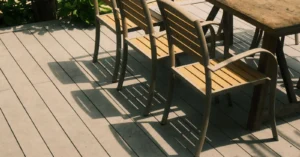

Most of the call-outs we get in December and January aren’t for storm damage, they’re for problems that started weeks earlier and got worse once the weather turned. A quick check of your fixings, drainage and surface grip now, before the first named storm of the season hits, will save you far more hassle than waiting until a board lifts or a post starts to wobble. If your deck is more than eight or nine years old, this is also the point where it’s worth deciding if you’re maintaining it or heading towards a replacement.
The mistake we see every November in Dublin gardens
People treat decking like it looks after itself once it’s down. It doesn’t, especially not here. The job we get called out for more than any other in winter is a timber deck that’s gone black and slick with algae, usually in a shaded spot behind a house extension or under trees, and someone has slipped on it. The second most common is water pooling against the house wall because leaves and silt have blocked the gaps between boards, which then wicks damp up into the joists underneath.
Both of these are preventable with about twenty minutes’ work. A stiff brush, a power wash on a low setting (not a close-range blast, which can strip the grain on softwood), and clearing the gaps between boards with a scraper or an old bread knife. Do it before the wet weather properly sets in, not after.
Why exposed and coastal gardens take the worst of it
Dublin isn’t one climate. A sheltered garden in Rathfarnham or Terenure, tucked behind rows of houses, copes with winter very differently to an open site in Clontarf, Dun Laoghaire or Blackrock where the wind comes straight off the bay. Salt-laden wind accelerates corrosion on cheap fixings and speeds up weathering on timber. We also see more wind-related problems on raised decks and elevated balconies in these areas, simply because they catch more of it. If your deck is raised more than a step or two off the ground, it’s worth having the structural fixings checked every couple of years regardless of how it looks on the surface, because the frame takes the strain long before the boards show any sign of trouble. We cover this in more detail on our raised decking page if that’s the type you have.
Gardens with heavy clay soil, which is common across a lot of older Dublin housing stock, also drain poorly after sustained rain. If your deck sits low and you notice standing water nearby after a storm, that moisture is sitting against your deck frame for longer than it should. It’s one of the main reasons timber decks in low-lying gardens rot from the underside first, long before the top surface looks like there’s a problem.
A pre-storm checklist worth doing yourself
You don’t need to be a tradesperson to do most of this. Set aside an hour before the next spell of bad weather and go through this:
- Check every handrail and post by hand, pushing firmly side to side. Any movement at all means a fixing has worked loose or started to rot.
- Look underneath the deck (a torch helps) for green or black staining, soft or spongy timber, or joists sitting in standing water.
- Clear leaves, moss and silt from between the boards, particularly where the deck meets the house wall or a downpipe.
- Check that any steps or ramps still have good grip. Algae builds up fastest on north-facing or shaded steps.
- Look at the fixings. Rust streaks running down a board usually mean a cheaper fixing was used originally and it’s starting to fail.
- If you have outdoor furniture, planters or a hot tub on the deck, lift them off if a storm warning is issued. Wind gets underneath flat surfaces and it’s heavier items that end up doing structural damage.
None of this is complicated. The point is to catch small issues while they’re still small, and before a named storm puts real load through a weak point you didn’t know was there.
Timber or composite, which copes better with a Dublin winter
This comes up a lot once people see what their timber deck looks like after a few wet winters, so here’s a straight comparison based on what we actually see in Dublin gardens:
| Timber decking | Composite decking |
|---|---|
| Needs cleaning, re-oiling or staining roughly once a year to stay protected | No oiling or staining required, cleans with a brush and water |
| Can go slippery with algae in shaded or damp spots if not maintained | Textured surface generally holds grip better, though a build-up of grime still needs a clean |
| Natural look, warmer underfoot, generally lower upfront cost | Higher upfront cost, but far less ongoing maintenance over the years |
| More prone to movement, splitting or rot if drainage underneath is poor | More stable in wet conditions, doesn’t absorb water the same way |
Neither one is automatically the “right” answer. A lot of our Dublin customers with sheltered, well-drained gardens are perfectly happy sticking with timber decking and keeping up the annual maintenance. For exposed, shaded or low-lying sites where that maintenance keeps getting skipped, we’d generally steer people towards composite decking instead, because it takes the winter weathering out of the equation almost entirely.
When it’s a repair, and when it’s time to replace
A deck that’s basically sound but has a cracked board, a loose rail or a rusted fixing is a repair job, and usually a quick one. We handle these through our decking repairs service and most are sorted in a day.
Where it tips into replacement territory is when the problem is in the frame itself, the joists underneath rather than the boards on top. Soft, spongy timber you can push a screwdriver into, widespread rot rather than one damaged board, or a structure that’s been patched two or three times already, that’s a sign the whole thing is coming to the end of its working life. Trying to repair your way around a failing frame usually costs more over a couple of years than just doing a proper decking replacement once and getting another decade or more out of it.
What pushes the cost of any of this up or down is fairly consistent: the size of the deck, whether it’s raised or ground level, how easy the site is to access, whether the frame needs replacing as well as the boards, and whether you go with timber or composite. There’s no honest way to give you a figure without seeing the job, but we can give you a proper quote once we’ve had a look.
Get your deck checked before the weather turns
We’ve been installing and repairing decking across Dublin for over 21 years, from exposed coastal gardens in Dun Laoghaire to sheltered sites in Dundrum and Glasnevin, so we’ve a good sense of what each part of the county throws at a deck over a winter. If you’re not sure whether yours needs a quick repair, a bit of maintenance, or a full replacement, have a look through our decking services and get in touch through our contact page for an honest assessment before the next storm rolls in.
Frequently Asked Questions
How often should I check my deck during the winter in Dublin?
A proper check once before storm season starts and again after any severe weather warning is generally enough for most gardens. Exposed or coastal sites, and raised decks, benefit from an extra check mid-winter since they take more punishment from wind and rain.
Is it safe to use a power washer on timber decking?
Yes, but keep the nozzle a reasonable distance back and use a lower pressure setting, especially on older or softer timber. Blasting it too close can strip the surface fibres and leave the board rougher and more absorbent, which actually speeds up weathering.
My deck feels slightly springy in one spot, is that serious?
It can be. Springiness usually means a joist underneath has started to soften or a support post has shifted. It’s not something to leave, have it looked at before you put real weight on it, particularly before hosting anything over the winter.
Should I cover my deck for the winter?
We wouldn’t generally recommend fully covering a deck, as trapped moisture underneath a cover can do more harm than the open weather. Clearing debris regularly and making sure water can drain away is more effective than covering it over.
Does decking need planning permission in Dublin?
It depends on the height, size and location of the deck relative to your house and boundaries. Rules can vary by case, so always confirm the current position with Dublin City Council or your local authority before any raised or large-scale build.
Is it worth replacing a timber deck with composite to avoid winter maintenance?
If you’re finding you don’t have time to oil or clean a timber deck every year and it’s showing the effects, composite is worth considering. It costs more upfront but removes most of the seasonal upkeep, which suits a lot of busy households.